PLGA/PCL Micro-scaffold with Gradient Stiffness
3D-melt-printed PLGA 75:25 / PCL biphasic micro-scaffold with 50–150 µm interconnected pores and an apico-basal stiffness gradient mirroring the native follicular niche.
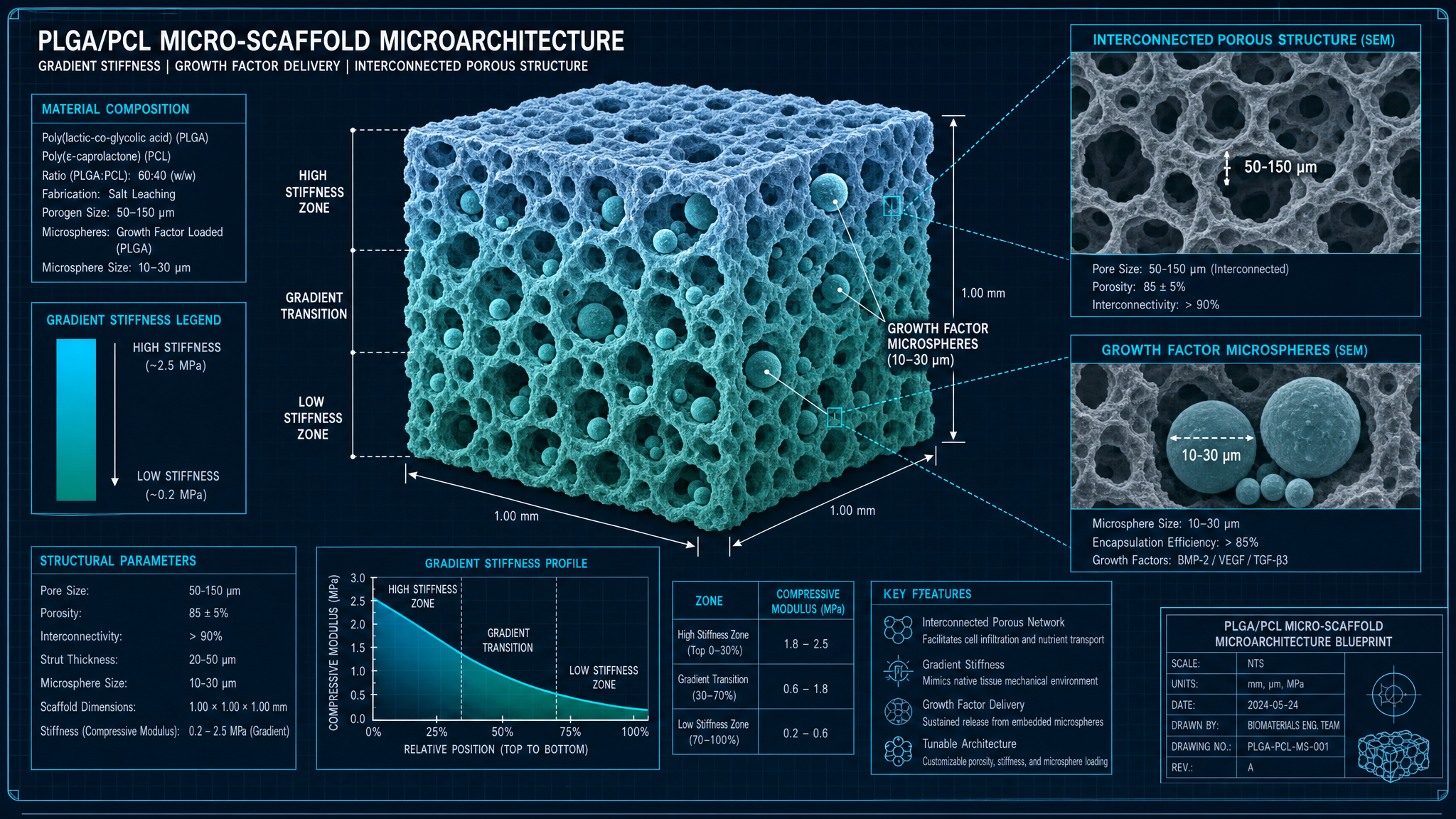
The structural backbone of the engineered follicle is a melt-electrowritten (MEW) PLGA(75:25)/PCL biphasic micro-scaffold, fabricated as a cylindrical lattice 0.9 mm OD × 4 mm. The MEW process holds fiber diameter at 18 ± 3 µm and produces interconnected porosity in the 50–150 µm range, validated by micro-CT (Bruker SkyScan 1272, 2 µm voxel).
A graded stiffness profile is achieved by progressively decreasing the PCL fraction along the apico-basal axis (upper bulge region 25 % PCL → lower bulb region 5 % PCL). This produces a measured compressive modulus gradient from 1.8 MPa apically to 0.18 MPa basally, mimicking the natural mechano-environment between rigid outer root sheath and compliant papilla.
Encapsulated PLGA microspheres (Ø 12 µm) carrying VEGF-165, PDGF-BB, and TGF-β3 are embedded in the basal third of the scaffold during the post-print solvent-annealing step. Degradation in vivo proceeds biphasically: PLGA mass loss 50 % at ≈ 6 weeks, PCL skeleton persisting beyond 12 weeks to provide mechanical support during follicular maturation.
Compressive modulus profile measured by nano-indentation along the long axis of the scaffold.
| Parameter | Value | Unit | Tolerance / Note |
|---|---|---|---|
| Polymer system | PLGA 75:25 + PCL | Gradient ratio | |
| Fabrication | Melt-electrowriting (MEW) | In-house 8-axis MEW | |
| Scaffold dim. | Ø0.9 × 4 | mm | |
| Fiber diameter | 18 ± 3 | µm | |
| Pore size | 50–150 | µm | µCT-validated |
| Apical modulus | 1.8 | MPa | Compressive |
| Basal modulus | 0.18 | MPa | |
| PLGA t½ in vivo | ~6 | weeks | |
| PCL persistence | >12 | weeks | |
| Endotoxin | <0.5 | EU/device | LAL test |